

On the 25th of October 2020 on social media, there were many pictures showing angry women shouting, protesting on the street and in front of the police in many places around Poland. I after discovered that on the 22nd of October, the Poland Constitutional Tribunal declared the law, authorising abortions for malformed foetus, to be unconstitutional.
Being foetus abnormalities the reason of most of the small number of official abortions in Poland, the news caused street protest in 60 polish towns in front of the ruling Party Law and Justice Offices (PIS), in front of religious administrations and a sit-in on the 25th of October.
The situation rapidly escalated with the intervention of the civil police sent by the Prime Minister Mateus Morawiecki, with the excuse of security against the COVID-19 pandemic.
Police intervention wasn’t soft, and people report its violence everywhere on the internet and this is how the situation got the world attention.
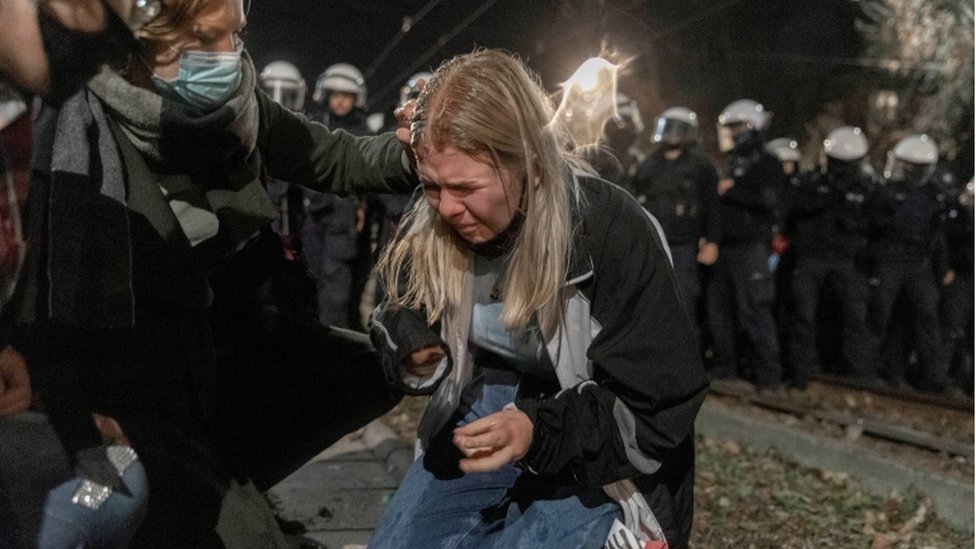
On the 30th of October 2020, about 100,000 people took to the streets of Polish capital, Warsaw, to join protest against the Polish government over its ruling on abortion rights and the United Nations criticized Poland court for this ban, highlighting the importance of men and women rights.
Poland, is one of the few countries in the world at the moment with the most restrictive abortion rules together with other very traditionally catholic countries as Malta, San Marino, Vatican, and Andorra, allowing abortion only in case of rape, incest , when the woman ‘s life or health is at risk or in cases of foetus abnormalities. Social, economic and personal reasons (a.k.a by choice) are not accepted and doctors executing abortion in these cases are subjected to penalty for illegal termination of pregnancy.
For this reason, many women travel to neighbour countries to practice abortion when their cases don’t fall in one of the situations mentioned above.
Poland abortion restrictive law is not something new and starts way behind back in history. In fact, until 1932 abortion in Poland was totally banned. After the second World War, because of the economic difficulties making hard for people and specially for women to sustain the family and even because women were continuing practicing abortion illegally, in 1956 abortion was legalized considering for the first time “difficult living condition,” a reason to do it. But then in 1990 it was removed, making access to abortion more difficult again.
In 2015 a civil initiative to introduce a complete ban on abortion was rejected in the Sejm (the Lower house of the bicameral parliament of Poland) and then again in April 2016 Polish organizations proposed amended legislation to ban abortion in all cases except to save woman’s life. For this, 30,000 women went on strike and marched in cities across the country to protest the legislation (known as the Black Protest), leading high-ranking politicians to distance themselves from the proposed law. Just three days after the strike, lawmakers voted against the new law.


What Poland population has been fighting till today is an issue that has been fought for long, and that is Sexual and Reproductive Health Rights: “concept of human rights applied to sexuality and reproduction”, or in simple words the rights and possibility to freely make choices about our body and our future, affecting our family welfare.
Abortion is part of the Sexual and Reproductive Rights defined by the World Health Organization as:
“……the recognition of the basic right of all couples and individuals to decide freely and responsibly the number, spacing and timing of their children and to have the information and means to do so, and the right to attain the highest standard of sexual and reproductive health. They also include the right of all to make decisions concerning reproduction free of discrimination, coercion and violence”
Family planning programs , where abortion and contraception play key roles, have always been a field differently organized by countries, even though at the International Conference on Population and Development (ICPD) in 1994 in Cairo, great importance was given to family planning shifting the discussion from an economic to a public health and human rights point of view and issue, with the development of a Program of Action , approved by 179 countries , affirming that sexual and reproductive health is an universal human right and outlining the need of improvement on reproductive health based around on free of choice, women’s empowerment and viewing sexual and reproductive health.
Abortion has been a controversial subject in many societies throughout history on religious, ethical, practical and political grounds. But it is a practice that exist as far back as 2700 BC in China and 1550 BC in Egypt, and the access and request vary widely by country basing on social, economic or personal reasons.
The right to have a safe and legal abortion is a fundamental human right protected under numerous international and regional human rights treaties and national-level constitutions around the world. These tools include abortion in a series of rights, including the rights to life, liberty, privacy, equality and non-discrimination and freedom from cruel, inhuman and degrading treatment. Human rights associations have repeatedly condemned restrictive abortion laws as being incompatible with human rights norms.
In the following 25 years since the ICPD, we have seen an overwhelming global trend toward the liberalization of abortion laws, with nearly 50 countries worldwide expanding the grounds under which abortion is legal: among them some reformed their laws to allow abortion on request ( Nepal, Guyana, Cambodia and Ireland) and others overturned complete band on abortion reforming their laws to permit it under various circumstances. Half of these countries that liberalized their abortion laws are in Africa.
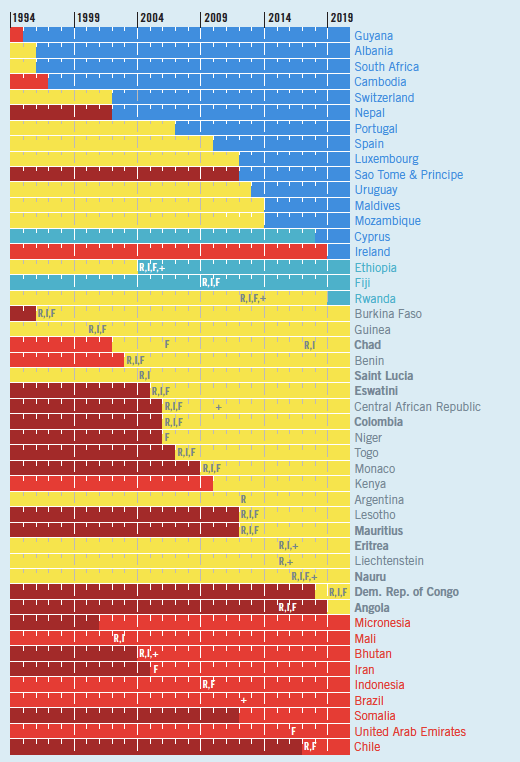
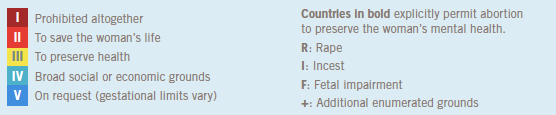
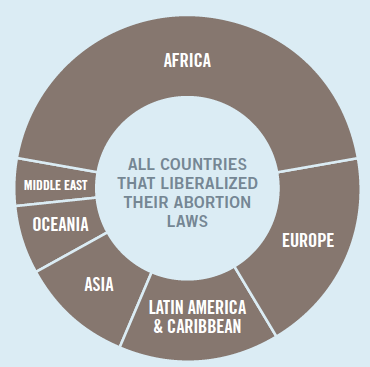
Furthermore, the number of abortions has declined worldwide due to increase of access to contraception.
Even though all this progression we still have among women of reproductive age (970 million women in the world) only 59% of them live in countries that broadly allow abortion and still 41 percent of women live under restrictive laws. The inability to access safe and legal abortion care impacts 700 million women of reproductive age with 23,000 women dying of unsafe abortion each year, according to the WHO, and tens of thousands more experiencing significant health complications.
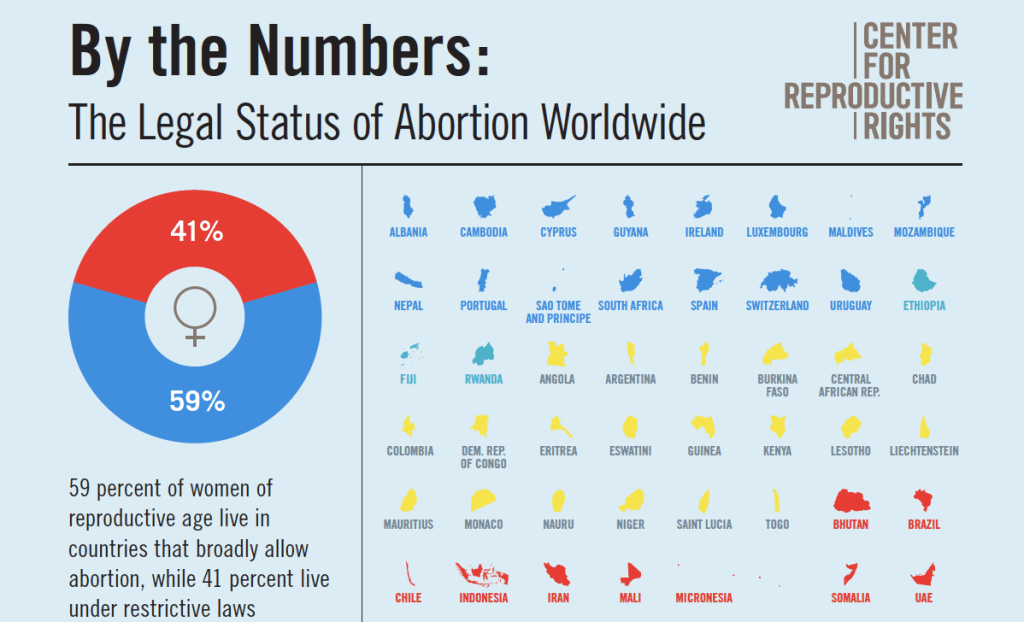
This means that legal restrictions on abortion do not result in fewer abortions but in women risking lives and health by seeking out unsafe abortion care.
And this take us back to Poland situation, and the reason why all this people are out there on the streets and the importance to raise awareness of the consequences this law can make.
Tracking the legal status of abortion shows us where women and girls are treated with equality and they can have the opportunity to direct the course of their own lives.
The legal status of abortion states more than just where women and girls are legally permitted to decide whether to stop a pregnancy or not. It reveals how likely a woman is to die from unsafe abortion, whether girls will complete their education, and the limits on women and girls’ ability to participate in public and political life.
It is not only about to choose how and when to do abortion, but is the right for the woman to choose about her life.
Resources:
. https://en.wikipedia.org/wiki/Abortion_in_Poland
. https://en.wikipedia.org/wiki/Abortion_law
. https://en.wikipedia.org/wiki/Reproductive_health
. https://en.wikipedia.org/wiki/Sexual_and_reproductive_health_and_rights
. https://reproductiverights.org/worldabortionlaws
. https://reproductiverights.org/document/worlds-abortion-laws-supplemental-publications
. https://www.theguardian.com/world/2020/nov/03/poland-stalls-abortion-ban-amid-nationwide-protests
 The Feminist Health CIC