
English Transcript of our Interview with Serena Lepri
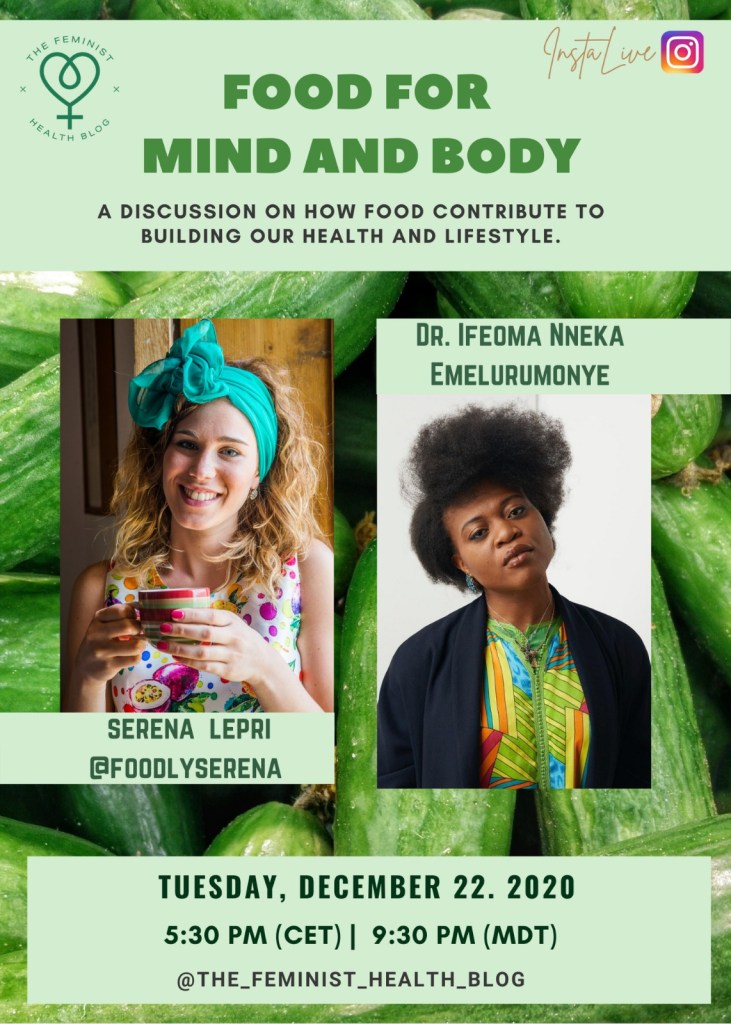
Ifeoma (I): Hi Serena and welcome to our space! For those who don’t know the Feminist Health Blog, it’s a blog created by Eunice, a Ghanaian girl living in Canada and me. We met in a congress and while chatting we were asking ourselves why they don’t talk enough about women. Then with the introduction of Gender Medicine, we took the opportunity to create this blog, during the pandemic. We discuss about all health conditions but even other themes that can be important for women to make their decision as woman empowerment and independence.
Serena (S): in fact, health is a 360° concept. I found your contents very interesting and I really liked them. Compliments!
I: Thank you!! This is very important for us. Today we want to talk about nutrition, an argument that I care a lot about, being a sporty person, going to gym and loving fitness. It is something fundamental for me. Thanks to my cousin Alessandra, I discovered you (Serena) and that you are helping Alessandra with her nutrition. So, I asked my cousin how she was doing with you and she told me all good things. I know it is a subjective experience, but considering you are a young entrepreneur woman and with these good feedbacks, I told myself why not asking her to do an interview with us, and she accepted guys! I am very happy!
S: Absolutely yes! Specially in this moment that we are staying a lot indoors it is lovely spending time in this way, entertaining but with scientific contents and, I think it is even an important topic. Thank you so much for having me.
I: Without further ado! Tell us a bit about you and what you do.
S: Hi my name is Serena, and I am a Nutritionist Biologist. I started my studies in my hometown Ancona at the Polytechnic University of Marche with the basic education of Biology. Then I became passionate of nutrition because the fact that we eat every day and many times during the day and to be aware of what we eat has always made me curious and I always wanted to know more about this aspect. I continued my studies at the University of Perugia where I specialized in Food Sciences. In Perugia I did some clinic studies that, you normally do, but I also discovered the deep connection between food, body and mind. So, I decided to specialize in eating disorders. My patients know that I care a lot about this duo, body and mind, and my approach with them is based on nutrition education. I believe so much in this. I collaborate even with psychologist because I don’t want to cross the line of my competency and I don’t want to interfere in their own work. Furthermore, I love cooking and do pictures. So, I combined all these items together and @foodlyserena came out from it!
I: In fact, @foodlyserena is a beautiful account and I have to say my curiosity came from Alessandra meal pictures that were very nice and inviting. In my opinion it’s important and maybe it helps to be motivated cooking nice and appetizing dishes.
S: I want people visiting my page to understand that to be on diet means even to be happy because often there isn’t this association. And if you notice my pictures are very colorful, even the ones of Alessandra, and I am happy that I could transmit this message.
I: Nutrition and diet: caring and problematic terms for women but actually also for men of our generation (finally I would say!). All of us we eat, even men. I imagine that every nutritionist, even if the subject is unique, has different approaches. What is yours to people who ask you for advice on their nutrition?
S: My clinical approach is inspired by the guidelines of the Mediterranean Diet. So, for those that did my same studies, I am talking of the CREA, SINU guidelines. Considering the Mediterranean diet, we eat something of everything, like the lifestyle of our grandparents and great grandparents. Having active lifestyle, eating many vegetables but not only that, even legumes and wholegrain foods. Guidelines say that the Mediterranean diet doesn’t have so many contra-indications. This in the long-term aspect, is something very important to consider. Naturally, as you mentioned, this diet has to be calibrated based on people taste, on how the person-food relationship is and even based on the time that the person has to cook, to do the shopping for food, considering we live in a world where, having the time for cooking and time for ourselves is not granted. So, my approach is then personalized, but we can say that with my clients, we work more on the awareness of what we want to obtain, of the awareness of our relationship with the food on the table. I have a clinic approach, giving a meal plan, with all the micros (carbohydrates, protein, fat and calories), but those are things that I know and, it is not fundamental that the patient knows too. The patient needs to work on himself. It is a journey where “you get naked” in all senses, because on the scale is an intimate moment and during the journey you really put yourself on the line.
I: I can imagine, and I see myself in everything you just said.
S: I am talking about both men and women!!
I: Exactly! I see myself in what you said because I think is very common for everyone during our life dwelling on our body, maybe while we are growing, like from 20 years on
S: In reality I think is even physiological. I am not educated enough for saying this important thing, but I think before and during our youth there are periods where we look more often ourselves in front of the mirror and maybe we use too much the scale. Then there is a very thin line, a very easy border to cross among having not a very positive relationship with the scale and having a healthy relationship with the scale. It is not easy.
I: No, it is not easy. Personally, my relationship with the scale until more or less 25 years old, has been connected with my visit to the sports doctor. That was the day that I normally knew my weight in that year.
S: I can say was not a bad relationship with the scale. The scale should be our friend, a guideline, to let us understand where we are going. At the end of the day on the scale you have a number, that doesn’t tell us if our weight is water or muscle.
I: True. I don’t if you ever heard about Gender Medicine. Gender Medicine, is a medicine that institutionally was born I think 2-3 years ago, that focuses the attention to gender during the studies, considering biological gender differences, as the hormonal ones, and so consider how drugs and clinic conditions can be different between men and women. In your profession, do you notice differences between what women asked you compared to men? Are they totally different or they have some things in common?
S: There are some things in common and others not. Usually, a woman in the first visit wants to lose weight, maybe after a pregnancy or during post-menopause, and the management of menopause is not simple and not experienced in a chill way by the woman. So, the main request of ladies is the weight loss. Men, usually, come to me for combining their gym workout with a correct nutrition, to have better results on their body shape. Mainly they want to develop more muscles. So, losing weight for the woman and different body structure for the man. But if you think about, in both situations, we are working on the relationship with our body. This is what men and women have in common, to have a correct nutrition. Because having a better nutrition is good for everybody and having a balanced diet is even a preventive medicine, not curing, unfortunately, it would have been too simple, but preventing. Reappropriating a good relationship with our body and with our body shapes, in my opinion and in my career, is what men and women have in common when they come to my clinic. Even men don’t have a good relationship with the scale. They see these numbers, that are difficult to interpretate. So, it is very important to guide both men and women to understand why sometimes we have a kg more or a kg less, what happens inside our body for example from the hormonal point of view. Us women, have often weight fluctuations during the month that are physiological and involved especially liquids.
I: Totally true. I remember taking a picture while I was in my period and I was a totally different person. In fact, considering the hormones point of view and hydric retention, you have different phases. If someone takes himself everyday a picture, will notice a notable changing. And we have to accept it, it is our body.
S: Exactly. And we have to even understand the period of the month that we are. And I am talking specially to women as we are influenced more of hormonal fluctuations compared to men. We have to take this in consideration and not be too frustrated and maybe not to weigh us during our menstruation, because that is not our normal weight. It will be a bad thing to do to ourselves.
I: This is important girls, loving us and not being too much severe and strict to ourselves. Obviously, if we are strict in our diet, in everything in our life as workout, job deadlines and so on, you will gain success. But it is even true that we need d to be self-critical but in the right way. Like “Did I made mistakes? That’s fine let’s move on”.
S: Yes. Specially, now that we are near Christmas. The most important thing is to be aware. Awareness is a characteristic that we have to develop specially, during a food journey that requires a big all-round effort from the person.
I: It all starts from our head. I have been followed for two months by a nutritionist and I understood that is mainly mentally.
S: Exactly. In fact, if we think about, following a menu is easy. Following a table plan like “on Monday I will eat this, on Tuesday I will eat that” and the quantities that the nutritionist gives you, it’s very easy to follow it. But after a while the nutritionist can’t always hold your hand and later you have to learn to be independent and learn to eat by yourself. And this the hardest part, and this is why there is the need of a journey of food education.
I: Totally agree. Always talking about women, we said that there are some things in common and some not with men. Instead considering different needs depending also on the periods of women’s life? (For example, differences between a student compared to a worker, between a new mother compared to a woman already in less break, etc.)
S: I have to say that I don’t have many young girls that I am following, I have more menopause women or in pregnancy, and post pregnancy women. Menopause women’s requests are to lose weight and managing their weight, as we were saying before. Even a work of acceptance of body shapes that, is a physiological thing during this period. Menopause is physiological, is not a disease and we need to work on this a lot. When I don’t think I am able, because I don’t have the competencies, I normally advice, in a soft way, to combine the meal plan journey with a psychologist or psychotherapist consultation. Young girls normally, want to find a better nutrition or want to dispel false myths, mainly.
I: For example?
S: Carbohydrates!! That I love and all of you should!! Normally girls, but even young boys, are scared of carbohydrates, considered a very bad entity. And carbohydrates in reality, alone don’t exists. It doesn’t exist a food that contains only carbohydrates, because for its definition is a mix of nutrients.
I: it is very important what you said, because we don’t realize it. Food consists of many components.
S: It’s true that when you eat pasta or bread you take mainly carbohydrates and, to simplify we say pasta is equal carbohydrates. But is not like that: in 100 gram of pasta there is 12-13 gram of protein that shouldn’t be under-estimate. They are vegetarian proteins and so different from the animal ones but they are still important. We try to work on debunk these false myths in youths. I noticed this difference.
I: Interesting. Instead, are there any important genetic/hereditary differences to consider when embarking on a diet and/or losing weight?
S: Yes, there are and definitely to be considered. In fact, the first visit takes more or less 45 minutes or an hour, depending on the clinic case. But we do a family anamnesis, asking if there has been or there is any overweight situation, a diabetes history, and so on. We try to see if there is a familiarity and/or a genetic predisposition for any particular disease. These aspects are important to consider, because there could be a particular food that should be avoid or limit if there are some hereditary disease, maybe not already manifested but that can come out later. It is important the genetic and the metabolism: we are talking even about chemical reactions that occur inside our body. What we eat is what we see externally and consequently, what the person that goes to the nutritionist has to care about. Then the biochemical reactions and everything that happens inside our body is something that concern the professional. So eventually we even do further analysis, and here we need the support of the medical doctor. In fact, I often collaborate with gastroenterologist.
I: Sure. Instead for example being a sporty black woman would I have a different approached compared to a white Caucasian slim girl? Because what I have noticed is that maybe black people receive a not adequate diet, similar to all other people, without consider maybe the ethnicity, the body shape, or other similar factors. I wanted to know your opinion about it.
S: There are some differences that, if the professional is good, has to follow the guidelines for consider them. For example, if the World Health Organization says certain things, myself that I am the last arrived in the business, I won’t be able ,for now, to value my opinion. And this is even for the different diet approaches. They are many, and some are efficient, not only the Mediterranean one, but guidelines talk. So, we have to take these factors in consideration for sure, the difference of ethnicity, gender, if you are a sporty or sedentary person. But we have even to consider the protein point of view, not only in calories intake, but even in changes of the quantities of proteins that we have to take. But don’t believe that we have to intake so many proteins and eat so many protein foods more, compared to a sedentary person. To mention some numbers: a sedentary person should eat more or less 0.8 gr of proteins per kg of body weight, so less of 1 gr; a sporty person, somebody that does agonism should intake 2 gr of protein. The difference is very small. And even here, boys often come asking for a hyporproteic meal plan. And we have a conversation of how the muscles build from the histological point of view and how the muscle tissue is made. It is not a tissue that accumulated proteins, we would love to be like that. Eating only more proteins is not enough, but mainly we need to do physical activity and the particular physical activity. But we have to consider the person: the journey, the workout and the meal plan will be personalized.
I: Thank you for your answer. One problem that often we have, is to start super strict and super healthy diets and then, unfortunately, “slip” soon after. We get demoralized, we say to ourselves, “This is not for me”. We “slip” off for many reasons. In my case my biggest problem is and has been my mental state, which is to eat emotionally (I’m happy I eat, I’m down and/or depressed I eat even more, and I drink too! I will drink a glass of red wine 1,2 3 or 4 times a week). And I think it’s common for many others to have the difficulty of staying in line and being motivated. What are the reasons for our difficulties and what advice would you give to face the various obstacles?
S: It happens often to get demoralized, as you said. Firstly, it is difficult, but food shouldn’t be used as a compensatory mechanism. It shouldn’t be, but it happens even to those that don’t have nutrition problems. This is even maybe a cultural heritage. But if it happens and we are maybe doing a meal journey in that occasion, with a nutritionist, we should take that occasion for working on ourselves and ask us “why did it happen?”. “Why did I slip off”? If for example the cause is emotional like the one that happened to you, it is important to work on that and see what type of behaviours strategies could be done for containing a problem that could be more or less small. Because maybe if I am the one to slip off, I would be “Whatever! Tomorrow I will start again following my nutrition”. Instead, if it happens to other they will instead get demoralized easily. So, I would say it is important to learn how we are and how we function, not only from the anatomy point of view but even from the physiology point of view. We have to understand that if we slip off once, lucky our body is not so fast and intelligent to transform everything we eat in fat. So, I can’t put on weight because I slept off once. This should make us reflect that if one day I ate more because I was sad or happy, because I had more social event than normally, in that period, the important thing is that I’ll immediately get right on track and as soon as possible and get on my normal balance of my everyday life. I need to go back on track, because nothing is lost. And with Christmas season nearby, food is even conviviality, for staying together, with our family even though this year is particular. This is why we should enjoy more the food this period!! So, we have to enjoy food that is not part of our diet, and then eat as we normally do specially if we are doing a journey, without many regrets. It is not easy, but my advice is to try to go immediately on track and don’t give up.
Somebody from the live said that because of the festive season is going to eat slices of panettone.
S: If you happens to eat one, two or more slices of panettone, sure do it. It won’t be that slice of panettone to ruin our nutrition balance. But this is a mental work. It is not easy, but there is the need of big will, even to not fall down again.
I: False myths! “No carbohydrates at dinner”, “red wine and dark chocolate are good”. I remember being in a dinner with few colleagues and we were talking about carbohydrates and there was a fraction supporting eating carbohydrate at dinner and the others against it.
S: But why? Are we different from morning to evening? A bit yes, but more or less we are the same.
I: Not only carbohydrates are among the nutrition myths. From the net and fitness social media, I could read even about dark chocolate, rather it is good or not. About red wine, I think there are even studies of its benefits….
S: Yeah, but we should be drunk all nights to have the amount of resveratrol, red wine antioxidant, for having some benefits. So, concerning carbohydrates yes or no in the evening, absolutely yes. But I am not the one decided this because I woke up one morning and said, “ok yes, let’s eat carbohydrates in the evening”. Guidelines and chemical reactions told us so, because what makes us tells us that we can eat them. Maybe the thing that we should give attention is the fact that normally after dinner I go to sleep or I will watch tv on the sofa, so I am more sedentary compared to the other period of the day, so I will reduce the amount of carbohydrates food in the evening. But carbohydrates even help to relax and to fall asleep. So, for dinner, why not? They help even with the production of endorphins and serotonins. So, I would say yes, I am for the carbohydrates even at dinner. I always think this: bread, that many people hate, I think I eat it 5 times in a day. For breakfast, jam and bread; snack, oil and bread; for lunch if I don’t eat pasta, I eat bread; in the afternoon snack (bread and ham or bread and jam again) and even at dinner. And I consider myself on fit!!
I: Definitely! I remember in fact to read about carbohydrates helping with the sleep and production of endorphins. And in fact, as you said, why not carbohydrates for dinner?! Really depends on the quantity you take of it.
S: Furthermore carbohydrates, correct me if I mistake, from the metabolic point of view, are the first nutrients to be oxidised, to be burned. So, if we take the correct amount, they cannot be accumulated. If we take too much of them, the surplus will transform in triglyceride, in fat and then accumulated in the fat tissue. But mainly carbohydrates represent our fuel.
I: Absolutely, I confirm as a medical doctor.
S: See, there is the need of a medical support
I: When we do a physical activity, the first thing that our body burns are carbohydrates and sugar, because are the easier one to find from the blood. Then later, if we do an activity of hours, we start burning fat. It is something that takes long because the reaction underneath is the Krebs cycle. For this reason, is true that we are eating carbohydrates, but we even burn them easily.
S: Exactly, and that is why I would like to dispel this false myth here. Concerning chocolate, it has some molecules as quercetin, that are very important for our body, with benefits for our health. But chocolate is a very high caloric food, so it always depends on the quantity and the frequency during the week that I eat chocolate.
I: The same thing you said before about the bread, is the same with chocolate for me. I am very weak with it, as I love it so much
S: In this case you should be able to stop yourself. You should take those 2-3 pieces of chocolate, then you put the chocolate confection in the fridge and you go away from the kitchen!! This is a strategy I do personally and, I prefer. For example, dark chocolate has a more efficient antioxidant and beneficial effect, compared to milk chocolate, because it seems that milk components obstacle the antioxidant effect of the chocolate.
I: There are many trends in diets, such as the paleo diet, the ketogenic diet, intermittent fasting that nowadays is very popular. In my experience, being a Catholic I fasted for the Lenten season this year. I started fasting 16 hours and, reduced it because I did it during the first pandemic wave and I was very stressful mentally. But I wanted to continue, so I did a fasting of 10-12 hours, depending on what time I was going to have lunch in the hospital. And in fact, I lost a lot of weight due even the big stress and tiredness connected with work.
S: But then, what happened when you started to eat normally after finished fasting?
I: I took a lot of weight, gradually. I kept the weight lost with the fasting for all the summer. Then, since the second pandemic wave, due to another situation and how we are now used to live with the virus, I put on weight.
S: The problem with the innovative approaches of these diets compared to the Mediterranean one, is that they are very strict, very strict. You told me you have not tried the ketogenic one, where for example you do not eat carbohydrates at all. And this is why is very famous, because many of us repudiate carbohydrates. Even the palaeolithic diet, inspired from the primitive man era, the zone diet, they have all very strict approaches that are not good for our mind and our approach with food. Another problem with these approaches is that are practicable in a short-term, both from a health point of view (kidneys and liver are affected) but even from a boring point of view. So later we start to eat again as we know, because our culture is a Mediterranean one. Maybe then we mistake the quantity and the seasonings, and here nutritionist helps. But when we start to eat as before we then experienced the yo-yo effect that we all fear. In the restriction period my body lost a lot and when later I start again to eat I am not trained to eat in a balanced way, and I will gain all the kilos with interest. This happens because my metabolism is waiting another period of starvation and, we get back to eat normally, I will accumulate and accumulate, because my body is used to a different type of nutrition. This thing came from the primitive men, but it has nothing to do with palaeolithic diet. It is in our DNA that we tend to accumulate.
I: In fact, I was looking at my pictures and videos of months ago and I put on weight. And the scale talks and math doesn’t lie, and probably is because of this yo-yo effect, with being more relaxed in this phase and eating normally, I accumulated weight.
S: It’s normal. And a year, as a period of time it is wide, and many things can happen and because we know that food is very connected with mind, it is normally to have a “no” period. So, we don’t have to be too rigid with ourselves.
I: Instead, question that came to my mind today, is the relationship with the scale. Always through personal trainer, they stressed out a lot to not focus only on what the scale says but even to watch our body changes, and maybe the changes in centimetres of our waist, hips, and so on. This because a person might do a particular workout, like lifting weights, and not losing a lot of kg from the scale but look different, maybe more tight, more tonic, flat stomach. On Instagram there are a lot of people that take pictures in different period of time and see the changing during that period
S: I don’t really like all these pictures; we look like objects. Taking picture of before and later what is it? There is not a before and later in my opinion but is true what you are saying.
I: I wanted to know from your point of view, what do you think of this approach of check your weight on the scale but even look at yourself. This is because when I got to, maybe, my best weight, the nutritionist at that time told me that I wouldn’t go beyond that weight. But I could work on my stomach bloating and fat around the abdomen through a better diet.
S: So, you reached your set point weight.
I: Yes, thanks to the diet but even with lifting weight workouts. Something that it is important for me to say is that we always consider this type of training a masculine one, and instead it can help you to lose weight.
S: Absolutely. I partially agree of what you said. The scale weight is not everything, but it is an important indicator of the direction we have to take. It is an objective indicator of our journey and let us know if we are reaching or going far from our goal. But 1 kg of muscle and 1 kg of fat, is always one kg. When I go on the scale I won’t see if I put on weight of fat, or I went a lot to the gym and I put 1kg of muscle. The scale won’t tell us this. But fat has a bigger volume than muscle that is instead more solid. So, I can see the difference from the cm that I measure on the waist. And in fact, there are some parameters that, I might sound boring, the guidelines say to consider like waist and hip circumferences, that are important parameters to consider for health and for reaching our goal. So maybe your weight might be the same, but you lost cm, your trousers are large, and why do I weight the same? Because maybe I gained in body composition, maybe in muscle. Scale doesn’t say all, but it is important, it is a tool that you have to know how to interpret. Then they exist even other scales that can tell you your body composition, like the impedinzometry: with an electric current, taking advantage that we are a good electrical conductor being full of water, through an inverse formula, the machine proceeds lean and fat mass. It would be helpful to combined scale numbers and this information. So, yes to the scale but with an interpretation.
I: Good, I agree. In fact, I see many examples especially in those at the the gym or in body builder, giving example of how your body can change without a great loss of weight. And from them I started to look at myself more, the possible differences and, measuring myself.
S: Anyway, as you said, you can take pictures. I don’t really like do it in the ambulatory because I like more working on ourselves than a physical and aesthetic result. But in a planned meal there is even an aesthetic part: watching yourself in the mirror and feel better, is it even important!
I: Well last question! Christmas is just around the corner and although this year certainly lunches and dinners will be moderate, we would still have the opportunity to eat satiety with a few intimates. What is the best nutritional advice you can give us during this time, so we don’t feel too guilty in January?
S: Well guilty feeling shouldn’t be part of us, because if I follow in the correct way a balanced nutrition, and I try to be careful as much as possible during the week, it won’t be that weekend of slip off that will ruin all my sacrifices and my work. If we think about during Christmas, there are 2-3 meals where I eat a bit more. So, I feel to advice to enjoy the moment of the eating in total relax and take advantage of this period to stay with your family as much as possible. Even because we couldn’t be with them so much in this period, being social distancing. Even if with the mask. Maybe during the meal, we can try to reduce the quantity, so eating small but everything: if we want to eat both panettone e pandoro, I will eat half slice of panettone and half slice of pandoro. Then another mistake to avoid is to fast from a meal to another meal, often thinking to do a calorie compensation: I ate a lot today, like 3000 calories during a meal, so I will skip the dinner to balance my calories intake for tomorrow. It is true that we are even made of maths, but it is not guarantee, this passage is not immediate. So do not fast, if not the next day we will be hungrier and on the cheat day we will desire to eat even the table!! We can eat something light, but no fasting. Another thing: let’s not fast in the period from 25th till 31st. I have to continue to eat normally, and no fasting. This is an advice and an order!! We need to contain as much as possible to slip off, that for sure! And a way to do it, for example, is to write on the calendar some events that I know in those day I will eat a bit more or different. But want I want to stress, and maybe I might sound boring and repetitive because heard from other people, we don’t put on weight from Christmas to New Year, but from New year to Christmas. So they aren’t that 10 days that will make us put on weight, but the other 355. Let’s enjoy our Christmas, drink a lot of water and be more active as possible even though the gyms are closed.
 The Feminist Health CIC