
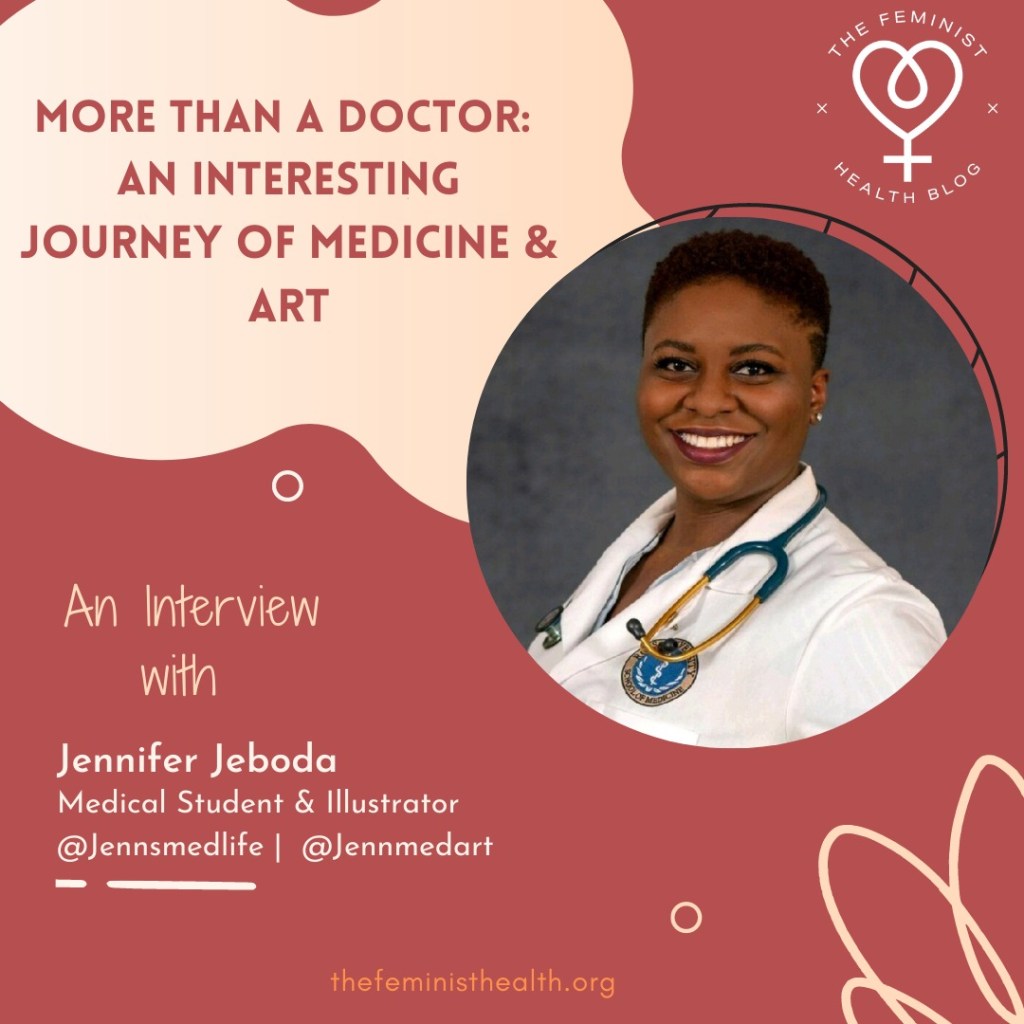
Medicine is a very fascinating subject and discipline. Furthermore it is one of the most difficult courses to do, both for the length and for the type of career you are going to have: to cure and care for people. That is why deciding to start medical studies is a hard decision and you’ll often question yourself “Am I really sure?”. This is one of the reasons why Jenn Jeboda, or better known as @jennsmedlife, started to share her student experience: to show her medical life from the lessons to the hospital rotations, in order to help others to understand better if this could be their path. We sat down with Jenn to and talk about her journey that, we have to admit, is very amazing and peculiar at the same time. Enjoy!
The Feminist Health Blog: Thank you so much for accepting our invitation. Can you please tell us a little bit about yourself?
Jennifer Jeboda: Thank you for having me! My name is Jennifer Jeboda, I was born in the UK, and I lived there until I was about 11-12 years old after which my parents sent my brother and I to boarding school in Nigeria. I went for 2 years and my brother joined me on my second year. We left for the US for another boarding school where I did high school, college, and other programs. Then I got my master’s degree at Morehouse School of Medicine and later decided to apply for medical school. My original plan was to apply for medical school straight after college, but God can laugh at your plans sometimes. Through a series contemplations and decisions, I decided to go to Ross University School of Medicine. A lot of things have transpired since starting medical school, but I am now in the UK doing my clinical rotations for a year and I will be done in about a month.
TFHB: Yeah! Well, done!!
J: Yeah, thank you. There is a lot of extra things in there. My life is very interesting to say the least, it’s very sporadic. Everything that I have planned, did not go as planned. Let me just say that.
TFHB: You are back at your roots. You started from one point, you travelled, travelled, travelled and went back on that point. Maybe that was destiny, who knows?
J: Exactly! Because honestly this opportunity became available only after COVID. I was supposed to be in California for my clinical rotations, but COVID happened and that plan cancelled and opened up the UK. I was surprised with the way everything turned out, it was crazy. I am just 20 minutes away from my home which is great. I near my family and friends again! Amazing. I haven’t seen them in 10 years, so it is a blessing.
TFHB: And in COVID time to have family nearby it is something very important. Different types of education systems give you more adaptive skills. It is interesting and I think there were some difficulties you found starting your education in one place and continuing in another place. Even if you did your primary and secondary school in the UK, you went to the US and then you went back to the UK. Which difficulties did you encounter having your education in different countries?
J: Well, when I first move to the US from Nigeria, it was a bit of a culture shock at first. I really had to adapt; it is something that I realized by myself. There were some things that happened in Nigeria that could not happen in the UK. Like spanking when I get bad grades or when I didn’t show up on time to a place, stuff like that. But that motivated me in a way to become more disciplined. But education in Nigeria is different, because they teach you things that I probably wouldn’t have learned while being in the UK, stuff like agriculture, certain advanced maths and science courses. It was very different, but again, I adjusted. Even though I attended boarding schools in both places, it was very different in the US compared to Nigeria. They weren’t as strict as they were in Nigeria. I think in Nigeria boarding school was more military style, but in the U.S., it was more relaxed, and the education style was also different. It was a college preparation school, and it was built to prepare you for college. It was a good school, and I had a lot of interesting experiences: I went on a lot of trips and excursions. Medical school in the Caribbean is U.S based so it is pretty much like U.S. studies. Coming back to the UK, the major differences that I have seen were how the health professionals are named (I have a YouTube video that describes the differences and changes between the UK and the U.S.). For example, in the U.S. they call the Senior Doctors, Attendings. Meanwhile, in the U.K they call them Consultants. I don’t know what it is like in Italy.
TFHB: They call them “strutturati”, like Structured Doctors. We have consultants, but not with the same meaning. They are called Consultants when one goes for a visit but not because you finish your specialization you become a consultant, they are specialist
J: Also, in the US you just have the Residents or the Attendees as doctors, simple, but in the UK, they have a list of different names for each specialty year. Another thing I had to relearn (again) was the unit system; the UK uses the metric system, whereas the US uses the imperial system. That was a little challenging to do because there’s a lot of values to memorize in the medical field. There were other little differences between UK and US that I had to get used to, but again, I adapted.
TFHB: Even though medicine is universal obviously to adapt to a different structure, that is important to learn in order to navigate for studying and working, is still difficult and challenging. But you made it! You should be proud!
J: Also, I want to mention that medical school here is 6 years, in US it’s 4 years. Also, when you become a doctor here in the U.K., you still rotate through all different specialities in the first two-three years. Whereas, in the U.S., you choose your specialty before you graduate, and you go into that speciality and that’s it. Training here in the U.K. is so much longer than U.S.
TFHB: I feel like U.S. medical studies are similar to the Italian’s ones. But at the end of the day the most important thing is that we all become good doctors, and you made the crazy decision to become one! Lol! A very long journey! I remember I asked you if you already knew the specialization you would like to do and you mentioned gynaecologist and surgery. Have you changed your mind? Is there one that you prefer instead of the others? And, can you tell us why you decide to study medicine and why you would like to start one of these specializations you are going to talk about?
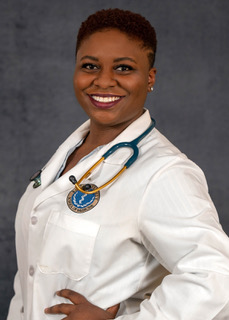
J: I couldn’t see myself doing anything other than being a doctor, honestly. All I ever thought about was being in the medical field and growing up, all the subjects that I ever loved were scientific. Science was the only subject that captured my mind and attention so, I knew I would be in the medical field for sure. Being a doctor is actually my calling. I’ve always wanted to be a healer and help people in a way that others could not.As far as specialties go, I used to be so excited when people would ask me what specialty I wanted to do, now I get just frustrated because I don’t know anymore! First, I thought I was going to be a paediatrician when I first started medicine, and then when I actually started medical school I was introduced to surgery and I was like “wow, this is so amazing!” Surgery was also my first rotation and I loved it. My second rotation was Ob/Gyn that I loved too. I love both, so I am like “what I am going to do?” People tell you that the first thing to decide when considering a specialty is to choose between a surgical and clinical specialization, but… I like both. I am also taking lifestyle into consideration; surgeons don’t have the greatest lifestyle, at least not until after residency. I love my life and my free time, because I am an artist, so I love to create and I even have a business on the side too. I’m also thinking about time with my future family, events etc, but I also adore medicine, so it’s a really hard decision for me, even though I have to make a decision very soon. Right now, I am trying to decide between paediatrics, surgery (specifically paediatric surgery), anaesthesiology is on the list now and also Ob/Gyn.
TFHB: Another thing to consider in my opinion is the work offer after the specialization: which are the specializations that have more job offers at the end of the residency? Anaesthesiology here, but even globally, for example is one of the most requested profession. But not everybody like it. That is another thing I will suggest you to consider based on where you would like to work, what is the job offer in that country and if those professions give you the lifestyle you want. You will figure it out.
J: Let me put it this way. If it was completely up to me and if the training was not so long, I would become a paediatric plastics and reconstructive surgeon. But 10 years of training before I even start a job… I don’t know, we’ll see…
TFHB:Sure! I mean at least you have 3-4 options to consider and to reflect the pros and cons, that will help you to decide. As soon as Ornella introduced me to you, I saw your Instagram page, @jennsmedlife, that is really cool. For what I understand is kind of a diary of your medical life, from lessons to rotations. Can you tell us how you came up with this idea to share your struggles and your joy?
J: So I’ve seen people do something similar with their IG stories, where they discus events that take place in their clinical placements, but I haven’t really seen anyone gone as in-depth as I am doing right now. For some reason, I knew my UK experience would be very different from the US, so I thought “hmm let me document what I will be doing, let me allow people see what the medical life is like over here”. So that is how I started! Once I started, I got such a warming response, so many people kept messaging me, telling me how much they loved my stories and how much they actually learn from them! I’ve even had other students tell me they are learning from my stories. So yeah, this is how I started and now I don’t want to stop because people are learning things like medical terms, medical procedures and even fun medical facts about themselves. I’ve also had people tell me how my IG stories have convinced them to work on their cholesterol or their diet and even get vaccinated! I feel like I am helping in a way, even if it’s very small, before I become an actual doctor. Honestly, I didn’t expect this much of a response, I didn’t expect people to love it so much and I didn’t expect people to look forward to my stories! It has been a rewarding experience thus far. I also have a medical art page that I keep separate from my personal page, @jennmedart. I enjoy posting because I feel I am making a small difference in the world even if it is just through my stories, telling my experiences and drawing my art.
TFHB: Congrats! That is true and, I think that is something new and useful. I think it is very positive to see you share your experience and make them feel that finally that there is someone I can ask and get information. Because this is what we have to do as doctors at the end of the day, helping people. So, I am happy that you are getting feedbacks and I think it is a great page that is interesting, informative and educative. You should keep going as long as you can.
J: Thank you! That is something I want to do, to lower down the curtains so that people can see what is actually going on because people often have many misconceptions about medicine that is so far from true. And I also want them to know that even doctors are human beings, we are not perfect and we are going to make mistakes. People expect us to be these Gods, but no! We are just like you but trained in medicine, that’s all.
TFHB: Changing the topic, as a woman, unfortunately we still have gender inequalities in every field and medicine is not an exception. Have you ever experienced discrimination or inequalities being a woman, especially a black woman during your journey?
J: Personally, I haven’t had that experience, but I have seen it happen to other women in the medical field and especially to women of color. It’s never been said to me, but it is a popular opinion that women shouldn’t be or can’t be surgeons because they need to have time for the children and family. I do hear things like that, but I try not to let them affect my decision to choose surgery, if that’s what I decide. The only thing that could possibly deter me from choosing surgery would be the residency work-life balance not because someone else says that I cannot do something. It’s good to take sound advice from people, but always remember that where there is a will, there is a way.
TFHB: I really stand that you should do what you want to do. And even though someone says I don’t want to be a surgeon because I want to have family, it shouldn’t see as a weakness, but just a lifestyle decision, period. Because even men could say I want to have family and don’t want to be a surgeon.
J: Exactly. Everybody that I have told I wanted to do surgery, no one has come to me and said “Are you sure” because I am woman, or because I might get pregnant. They only admire it and maybe let me know that it won’t be easy. Again, that is only my experience, but I am sure there are other women out there who have been told that they can’t do that.
TFHB: Talking about balance, you have an art page, you study, you are doing your rotation and people say that they can’t do medicine because it is long, rigorous and, that is true! Furthermore, the competitions for good grades. Here, I want to ask you two questions that I believe are connected: how do you balance studies and been rigorous to finish this long journey and at the same time keep your mental sanity and a normal life? What are your thoughts, or do you believe you have to be an A+ student to study medicine?
J: How do I balance everything? It’s not a simple answer. I just take things a day at a time, because there is so much I am doing and there is so much I want to do. When I think about everything as a whole, I get stressed out and I have to remind myself “Just pull back Jenn and think about what you are doing right now?”. There are so many things I am doing: I am studying for medicine; I draw art for my own business, I draw art/graphics for other people’s businesses, I am balancing different organizations that I am part of, I like to workout, I like to have fun… there are so many things I take a day at time. So, studying is not all I do, and I don’t want it to takeover my whole life. There are so many different ways to incorporate your outside life into your medical life. Medicine isn’t only about sitting in front of a book/computer in your room to study. For example, I study wherever and whenever I can; I pull out my phone and do practice questions on the train or waiting for an appointment, I listen to medical topics while I’m driving. Also, sharing my experiences in my IG stories reinforces what I have learned during my clinical rotations or lessons. I just find little pockets of time and places to fit in the things that I need to do. Multitasking is also a very helpful skill, I can watch tv and at the same time draw medical art for my business, so I am doing two things at the same time. So yeah, that is how I find a way to balance everything. I also want to add, your mental health is everything: if you are not mentally sound and stressed out or anxious about school, it’s going to affect other aspects of your life. It’s important to have an outlet or a de-stressor. For me it is drawing because I find it very therapeutic, it is not only for business purposes; I could sit down for 9 hours straight and just draw. It’s also important to have people you can talk to regularly, for instance, I talk to my boyfriend and family often. There are many ways to make sure you stay on track with yourself and your mind. Working out and meditation also really help to clear my mind. I have noticed that when I don’t work out for one or two weeks, I feel drained, lazier and foggy, but when I start working out again, my mind clears up. And to answer your question, do I believe you need to be an A+ student or super smart to study medicine? NO! Not at all!
TFHB: Because you know what people say? “All medical doctors are so intelligent…”
J: Yeah, definitely not all of us!!
(Both laugh)
J: That is definitely not true. Being an A+ student doesn’t mean much other than you did well on all of your exams. I could be a C+ students and be the most amazing doctor. Being super smart is not a prerequisite for medical school.
TFHB: So true. There is a colleague, he is a cardiologist, super supersmart that I always say that if I would be a patient, I will be actually scared to be treated by him because he doesn’t have emotions, he is very cold. He loves data, science and research. When he started cardiology specialization, my friends told me that he made the senior doctors feel embarrassed because he was smarter than them. And that gave him a bad reputation because it seems he wanted to show off. I don’t have the feeling he will become a good clinical doctor. I see him more winning a Nobel prize or being a good scientist, but from the empathic point of view, I don’t see it. That is why I totally agree with you. And when they tell me we are all smart I answer, “unfortunately no”!
J: Exactly. That is why I want people to know you don’t have to be an amazingly smart person to be a doctor and it is unfortunate about the story you told me, because your colleague could use his knowledge for so much more, but if you just care about the disease more than the patient and don’t listen to the patient, how can you correctly diagnose and treat them?
TFHB: Exactly! What has been your life changing moment since you start medical school? Has something changed your perspective about life and medicine?
J: Let me first mention how it has changed my life. When I first started medical school, I came to the Caribbean, end of 2017, and went to the beautiful island of Dominica. My 4th week there, (I came 2 weeks earlier to enjoy the island, so I was in my second week of medical school) hurricane Maria, category 5, came and wiped out the island with all of us on it. Fortunately, all of us made it out alive but we needed to evacuate the island. Some of us made it off of the island by helicopter, ships or boats. I left in a pirate ship, literally. Before we evacuated the island, we were stuck there for days, without electricity or running water. Can you imagine what that was like?! All of the toilets were full, we had to find creative ways to take showers, we couldn’t get in contact with our loved ones, it was crazy! Starting medical school, I couldn’t imagine a hurricane would just completely stop my education, just like that. And that hurricane led up to a whole cascade of events, because when that happened, we were out of school for almost a whole month. We were all in the US waiting for the next move. Then finally, they gave us an option: to do medical school on a cruise ship or take the remainder of the semester off. They got an Italian cruise ship called GMV Excellence, I will never forget it, and they told us that we could do a semester there (on the island of St. Kitts and Nevis) while they figured out a more permanent solution for us. I was definitely not going to wait; I wanted my education to start and end as soon as possible, so I did my first full semester on a cruise ship. While it sounds glorious, it did have its good parts, but it also had its downsides too. We spent most of our time out at sea because we would only dock when there weren’t other cruise ships at the docks, but we got to explore the island whenever we did dock. Before we finished the semester on the cruise ship, they told us we had another temporary campus lined up for us, in Tennessee U.S., for a year. So, we went there, and I completed 3 semesters. We couldn’t go back to Dominica because it was destroyed by the hurricane, so they finally found us a permanent residence in Barbados. That was my last year of basic sciences considering my school is 2 years in the Caribbean and 2 years in the US, 4years in total. My first 2 years was supposed to be in Dominica, but after everything that happened, I was all over the place. After I finished in Barbados, my clinical experience was supposed to begin in L.A. California, but COVID happened. COVID came and stopped everything in its tracks. When things started back up again, a clinical track in the UK became available to us and so I decided to come home to the UK. I will be back in the US after this year is over. If the hurricane and COVID didn’t happen, I would have been finish with school by now because I had to take so much time off; a couple of months off because of the hurricane and travelling back and forth and then six months off because of COVID. All of these events changed my view on life because it made me realize how little control we have over our lives. It also changed my views on medicine because I had to experience medical studies in so many different countries and cultures. Most medical students, I would say 99% of them, practice and train in no more than one or two countries. I was in 5 different countries including a cruise ship! So much of my life has changed because of my wild medical journey and I am grateful for it. I wouldn’t change it, no matter how crazy, unpredictable, and stressful it has been, it’s also been really fun, I’ve learned a great deal and I got to see so many different people and live in so many different cultures. All of these experiences will aid me in becoming an amazing doctor.
TFHB: And from the medical perspective, did these experiences change the perspective of medicine a little bit? Or confirm something?
J: Yes, so I started drawing my medical art around the same time all of these events transpired. I’m not sure if it was just an awakening or what, but I am grateful for it because who knows if I would currently be helping other students or have a business, if it wasn’t for all that I went through. Also, I used to be terrible at anatomy, but since I started drawing my medical illustrations, I have gotten so much better. So, all of these events have changed my life and my medical life, for the better. It even changed my life, financially! I didn’t expect to make any money during my studies. Everybody said it was impossible, that you can’t work during medical school or you can’t do this or do that. Well, I found a way! This is why I say don’t listen to people who tell you what can or cannot happen. I am earning money during medical school, even though it is not a lot, it is still something and something is better than nothing. Now I know that as a doctor, I have the capacity to become a great businesswoman (private practice) and a physician.
TFHB: That was really an experience, I can’t imagine. And I am happy it went well and helped you in a positive way. Instead, what do you think is the hardest thing you have to be prepared for your job? What do you think is going to be the major difficulty you have to face when you start working as a doctor in general, apart from the specialization you are going to choose?
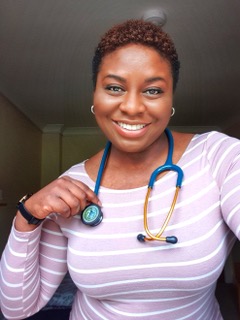
J: Definitely number one on that list are the working hours, especially in the US, working 70-80 hours every week in residency is insane!! Number two for me would be, dealing with insurance and them telling me what procedures or drugs my patients can and can’t receive. Number 3 is dealing with difficult patients: we think it’s not going to happen or hope it won’t, but not everybody is easy-going and not everyone listens. You have to be prepared for these things because it can draw you away from medicine if you’re not. I have seen it happen to many doctors. In specialties like surgery, it is super stressful and time consuming, so you have to learn to handle stress well also. Another major thing is dealing with death. As medical student I saw my first patient dying in front of my eyes in the ITU (Intensive Therapy Unit). He was very young and died from COVID. I will never forget, I was so upset and I didn’t think it was going to affect me the way that it did. You hear about people dying all the time, but right in front of you when you can’t do anything about it… it changed me. And to see that kind of thing happen over and over again as a doctor, that can definitely affect your psyche, because it isn’t easy seeing people die; some people get used to it and some people never do. It also depends on what specialty you do, in some specialities people die left and right every single day. So if you know you can’t handle death, maybe you should choose a specialty that doesn’t have so many deaths.
TFHB: I know it is hard. I remember there was a course in my university on how to communicate to the patient about bad prognosis and try to practice a bit to not to be too much involved and at the same time not too much cold.
J: Exactly, even in the US you have to be prepared for the US health system. To see people, suffer at the end of the healthcare system, makes doctors leave medicine too, because it is a lot to deal with.
TFHB: That is one of the reasons I cannot go and work in the US. Our last question: what is your advice and suggestions for any girl and woman out there that want to start a career in medicine?
J: First one is DO IT! We need doctors, especially black female doctors, we need them, we really do! So first of all, if you are thinking about it, just do it. It is not as crazy as it sounds and not as difficult as it sounds. When you get started, I promise, even if it seems hard at one point, like there is something you can’t remember, or a clinical examination you can’t do, I promise you will get it one day. As time goes on, it gets better with the knowledge that you learn and the clinical experiences that you retain. I remember at the beginning of first year I was thinking “How am I going to do these physical examinations?! I can’t remember all of that stuff!”, or “How am I going to learn all of these anatomical parts!?” But then when you look back, you will think “Wow, why was I so stressed then? I am doing it so easily now!” Secondly, I think it is good to find cooling mechanisms to stress. Stress can deter you from a lot. So, if you find a way to manage stress everything will be simpler. Oh! Also, don’t listen to everybody! You got to live life for yourself and nobody else. So, while receiving advice from other people is great, you have to take it with a grain of salt, because you cannot listen to what everybody says. Everybody’s experience is different and will always be different. When people tell you can’t do something, go ahead and disprove it for yourself first! This advice goes out, especially to women, there are so many people out there that will tell us we cannot do something, or we can’t balance business with this, or we can’t have children with that, etc, but it is not true! You go out there for yourself and you figure it out by yourself to see if you can do it or not and you might be surprised!!
TFHB: You raised a lot of good points and I am happy we had this conversation because your journey is definitely inspirational, and you faced a lot of challenges and I hope people will look at you and learn a lot and never give up. Our aim is to share stories so people can relate and be inspired. So, thank you once again, Jenn.
J: Thank you for having me!
Jennifer Jeboda was born and raised in London England, but as a triple citizen (UK, US and Nigeria) there isn’t really a particular place she considers “home”. Although she has gained education in several countries and lived in just as many, she has spent most of her adult life in the United States. Jennifer chose medicine partly because it chose her; the only topic she was ever truly interested in growing up was science, “I’ve literally disliked all other topics, everything else just seemed so boring to me”. Excelling in the sciences wasn’t the only thing that drew her to medicine, she loved the concept of using her brain and hands to heal people and making the quality of their lives better. As a medical student, she uses her artistic skills to help herself and other students across the world better understand anatomy and medicine. In the next 5-10 years, she aspires to teach students and heal patients with her art, medical knowledge and experiences. She is especially invested in the education of children and has ongoing plans on creating anatomy books for the kids.
 The Feminist Health CIC