
I have always considered the existence of an underlined but evident connection between medicine and art. Remember when we interviewed Dr Jennifer Jeboda who told us how she found mental peace, joy and even an income with medical illustration. But we are aware that art can be used as a practice of healing , care process and internal expression.
This is what art was even for the Nigerian painter Tonia Nneji. I found about Tonia through a Chiammanda Ngozi Adichie instagram post and as an art lover I founded the painting interesting and I did a deeper research about the artist.
I discovered a story of a strong woman fighting discrimination and stigma that many women in Nigeria and in all Africa and low income countries face due to infertility problem connected to Polycystic Ovary Syndrome (PCOS), a medical condition that causes an imbalance of reproductive hormones among women, as well as insomnia, weight gain and depression). PCOS is much common that we think (we made an article sometime ago) and even though is most of the time manageable and treatable, there is still so much stigma around it that many girls and women feel very uncomfortable to talk. Furthermore, being a complex syndrome involving not only the reproductive system but the hormonal, cardiovascular, dermatological and more other anatomical systems, the clinical expression is very different from person to person and this is a challenge for doctors to detect and even find the best treatment for the person. But in environments where still the main duty of women is to get married, have and take care of the children, imagine having PCOS and being possibly infertile, and also maybe not being able to have and/or pay for a consultation and visits, how hard life could be?
Tonia Nneji is from Imo State, in the South East of Nigeria, a predominately Igbo part of the country. In 2014, she was diagnosed with PCOS. She speaks openly about her clinical condition and in fact as soon as I discovered her page, the first thing you get to know is about her clinical condition. Why? To help other women out there in the same or similar condition to not feel too much alone and at the same time gave them support and help in order to care their condition and do not be a victim of culture suppression and shame for women. But even because art helped her healing process.
In Portrait of a Cyster, a self-portrait that sees the artist’s solitary figure in blue hues posed atop a swathe of brightly coloured fabrics, communicating her own suffering and the support she has found through sisterhood and sharing.
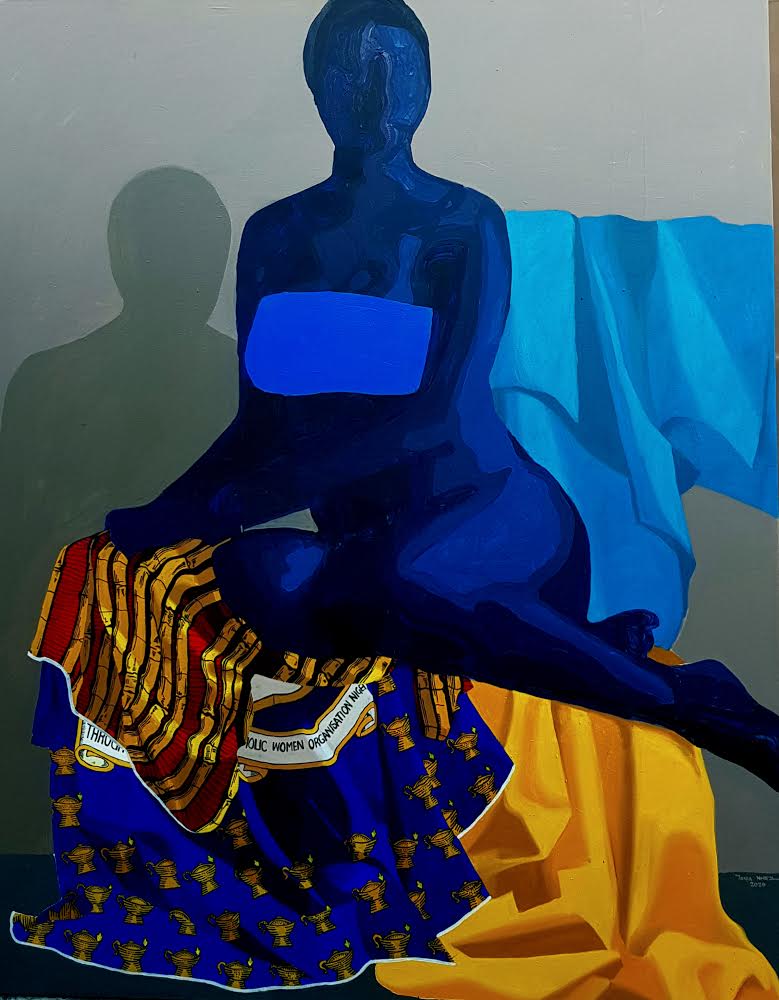
Nneji paintings caretheristic involved blue acrylic (a color used even by Picasso in his “Blue Period”, after the death of his dear friend as a suffering and mourning colour) with trademark featureless figures, exploring another way in which she has sought help. Her figures’ expressions are blank (an ambivalent gesture making these women possibly both every women but also invisible, overlooked), full of intimacy, using richly detailed, prismatic ankara fabrics to tell stories about her search for solace.
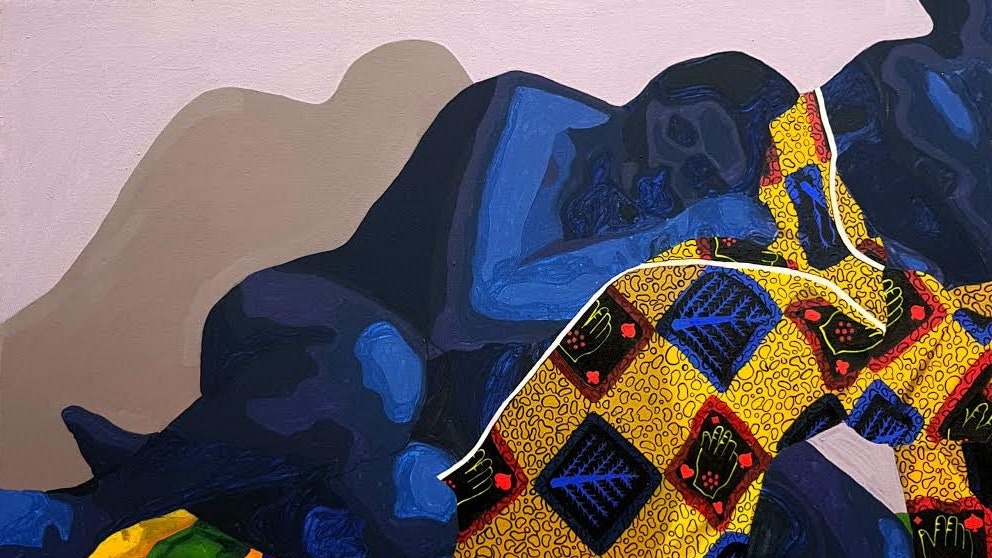
The motifs and drawings on these textiles represent names of local churches and other religious houses that Nneji visited in Lagos in search of solace. They are places she was initially reluctant to go to “but there’s always someone who cares about you and wants to take you to some church, hoping it will help your pain “(very typical in Nigerian, and I would say African environment). In the double portrait, A Dust Memory (A Trip to See Pastor Matthew in Ago—Hausa, Ajegunle, Lagos) the fabrics that cover the figures reference Kwara Baptist Conference and Women’s Missionary Union, both places the artist has visited in search of alternative therapies and treatments.

Nneji’s use of ankara has a particular significance for the artist. “When I have my episodes, I am completely naked. It is my mother who covers me with fabric,” she explains. Also ankara is connected with Nneji’s healing: her mother once had to sell her own collection of fabrics in order to cover medical bills. This is a sacrifice Nneji recognises specifically in her work, directly referencing the patterns and prints of these lost fabrics as a way to preserve them.
I found Tonia’s case and story one of the best example of the intimate connection that art and medicine can have. Not only because she helped her to face her clinical condition, but even to highlight one of the many stigmas present at the moment that should not remain as that but instead discussed allowing women to have cure options.
Follow artist Tonia Nneji, represented by Rele Gallery ( a Nigerian gallery!!), her work and projects.
But mostly do not be ashamed to talk about your worries and problems, especially if your health is concerned. And use any platforms and tool that will make you feel better, that will make you heal!
References:
 The Feminist Health CIC