
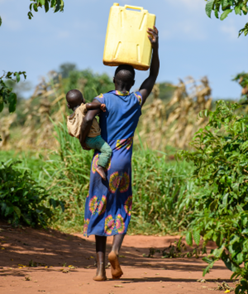
At age 13, Sandra gave birth to her son in northern Uganda. Young and alone, without a partner’s support, Sandra embarked on an unplanned and unwanted journey to motherhood. This new reality eclipsed her childhood, prospects of school, and her plans for the future. For months, she stayed hidden at home with only her mother…
Sandra is not an isolated case; an estimated 218 million women of reproductive age in low- and middle-income countries have an unmet need for modern contraception.[1] Over half of these women are living in sub–Saharan Africa and Southeast Asia and the majority are adolescents and young women between the ages of 15-24.[2] Unequal gender norms place girls and women at increased risk to experience sexual and gender-based violence and reduce their decision-making powers, including the ability to negotiate sex, pleasure, and condom use and access sexual and reproductive health services.[3] Additionally, partner resistance, lack of conveniently located services, dissatisfaction with contraceptive method options, stigma and shame, costs, and misinformation or lack of information are all significant barriers to sexual and reproductive health service access.[4],[5]
Universal access to family planning is a human right.[6] We all deserve to have agency to fulfill our reproductive health goals. The consequences of unfulfilled sexual and reproductive health rights are severe. Unplanned and unwanted pregnancy is strongly associated with maternal mortality either due to complications during high-risk pregnancies or lack of access to safe abortion.[7] Challenges to reproductive health rights are not unique to low- and middle-income countries. In the United States, a recent decision by the Supreme Court no longer ensures access to safe and legal abortion services for girls and women in all parts of the country, placing their health and lives at risk.[8]
Unmet contraception need also interferes with girls’ and women’s ability to obtain an education, access the labor market, and pursue their dreams in the manner that they envision for themselves, negatively influencing their socioeconomic wellbeing and life opportunities.[9] Unmet contraception need also exposes adolescent girls and unmarried women to shame and stigma from health providers, their communities, and their families, negatively impacting their mental health which is correlated with poorer maternal and infant outcomes.[10]
There is ample evidence that person-centered care improves individual and health system outcomes, and is widely attributed to reduce inequities, including gender inequities.[11],[12],[13] Person-centered care responds to an individual’s preferences, needs, and values, which are critical to reproductive health. Individual contraceptive preferences and reproductive health goals are influenced by a wide range of factors; these include racism, sexism, economic injustices, histories of trauma, and cultural preferences.In honor of World Contraception Day on September 26th, we at JSI reinforce our commitment to ensure that all girls and women can achieve their own reproductive life goals. In doing so, we have examined our own programs around the world to identify effective person-centered approaches that help ensure that all girls and women are able to fulfill their reproductive health rights.
“You cannot have maternal health without reproductive health. And reproductive health includes contraception and family planning and access to legal, safe abortion.”
– Hillary Clinton
Expanding Choice and Elevating Women’s Voices
Globally, we are working to introduce new family planning products to expand the method mix available to girls and women of reproductive age. We’ve contributed to a strategic planning guide, Contraceptive Method Introduction to Expand Choice, to help program managers and policymakers successfully introduce new contraceptive methods through public and private channels. Through the Access Collaborative, more than 20 countries have introduced and scaled up Depot medroxyprogesterone acetate sub-cutaneous (DMPA-SC) to expand the range of contraceptive methods available and deliver informed-choice programming so girls and women can decide which method is right for them at that time in their lives and aligned with their own reproductive goals.
“Family planning use is not only about access to services here. The person who provides services and how they provide them are equally important. A key component of person-centered care is informed and shared decision making. As pharmacists, we are the frontline providers because we are close to the community. Because I am female, women feel even more comfortable to come and see me… therefore, when they have a choice, they prefer a female pharmacist like myself.”
– Dr. Fathia, a JSI-trained pharmacist in Egypt
Improving Access to and Experience of Care
Person-centered care settings should be inviting, user-friendly, and minimize accessibility barriers such as affordability, availability, physical accessibility, and acceptability of services. In Nigeria, through the Access Collaborative, we partnered with the Federal Ministry of Health to launch a national guideline on self-care, including self-injectable contraceptives. Self-injectable contraceptives have the potential to help overcome a host of access-related barriers including privacy and transport barriers while increasing access to contraception and providing a way for girls and women to take control of their health. In Madagascar, we also supported training for healthcare providers to administer DMPA-SC and counsel women on how to self-inject. Up to 24 percent of women who adopted self-injection were new to family planning, demonstrating how provider ability and availability to train on self-injection increased access to contraception. In Zambia, we are working to integrate family planning services into all hospital entry points, including HIV services, to make family planning access easier and more convenient while reducing the number of times a woman needs to visit a health facility. In Indonesia JSI collaborated with stakeholders to design and implement a package of data-centric supply chain interventions to fill critical system gaps and improve data visibility, quality, and use for continuous supply chain improvement and, ultimately, contraceptive availability.
Respecting Culture and Identity through Community Health Workers
Using a “whole person” approach to care considers people’s contexts, lived experiences, their culture and identity, and where they are in their life course. An adolescent’s contraceptive needs and goals in an urban setting are different from the needs of an adult in a rural community. Person-centered care requires treating each person as a unique individual with respect, empathy, and understanding while providing accurate, easy to understand information about contraception based on the individual’s needs and goals. Also foundational to person-centered care in the context of contraception is assisting patients to select a contraceptive method that is best-suited for their individual situation in a manner that reflects their preferences for decision making. In Kenya, JSI and inSupply Health are working to increase equity in access to health commodities, including contraceptives, by developing sustainable and scalable community-based commodity distribution models. The team works in the arid and semiarid lands where nomadic and semi-nomadic pastoralist communities live. These communities have limited access to health services and their use of family planning is low. Supply data is used to promote better commodity resupply practices, ensuring that contraceptives are available to communities when they need them in alignment with their identity, including religious and cultural norms. In Madagascar, we are supporting nearly 10,000 community health volunteers to deliver a mix of contraceptive options within their communities including intra-uterine devices (IUDs), implants, injectables, among others. These services are regularly delivered in people’s homes along with sexual education, counseling, and involving partners to support family planning uptake.
Building Community Trust and Fostering Empathy
In Ethiopia, health extension workers (HEWs) are the backbone of Ethiopia’s success in increasing access to contraception. HEWs work to ensure that women and girls in the most remote parts of the country have information, services, and products. By serving the same communities that they come from (grew up in and currently reside) they are in a better position to safeguard trust and respect, which is paramount for person-centered contraceptive counseling care.
Let’s Get to Work: A Call to Action
Putting people at the center of reproductive health programs is essential to advancing girls’ and women’s sexual and reproductive rights and to make measurable advances in gender equity. Our global experience highlights clear actions required to ensure people-centered reproductive health services. These include:
At the policy level, let us put policies in place to ensure universal access to family planning services for girls and women in all country settings. Family planning policies should consider historical and social factors including racism, sexism, economic injustices, histories of trauma, and religious and cultural preferences, including self-care policies that allow women to make their own health decisions and use their choice of product in their preferred environment.
At the systems level, let us help to strengthen systems to ensure that the right mix of contraceptive commodities are available in the right place at the right time, and delivered in the manner preferred by the girls and women who are accessing them. We also need to ensure that health data systems are in place to support decision-making.
At the institutional level, let us get creative about how reproductive health services are delivered. If we have learned anything from COVID-19, it is that we can move critical services outside of health facilities and meet women where they are with high-quality friendly services that are delivered by outreach workers and community health workers.
At the community level, let us focus on strengthening the enabling environment to address the root causes of inequities that disrupt girls’ and women’s agency and access. These include norms that place stigma and shame on sexually active adolescent girls and unmarried women and gender norms that reduce their decision-making powers.
And critically, at the individual level, let us ensure that the voices, preferences, and needs of girls and women are continually gathered and used to develop reproductive health policies and programs so that we truly can achieve universal, person-centered reproductive health care, ensuring that all of us can fulfill our sexual and reproductive health rights.
For Sandra, accessible family planning services are helping to shape her future. At 14-years old, when her baby was one, Sandra decided to use family planning after hearing about it from one of her peers. For Sandra, the idea of family planning was not easy, but having been hurled into motherhood at a young age, she wanted to take charge of when to have her next child. Sandra has no regrets and is happy with her decision.
by Jessica Posner and Nicole Castle, JSI

Jessica Posner
Jessie is currently the Strategic Information Lead for the Center for HIV and Infectious Diseases at JSI. She has a master’s in public health from Tulane University’s School of Public Health and Tropical Medicine. Through her work at JSI she has worked with organizations both in the US and abroad, as well as governments and donors. Jessica is 43 years old and is a mother of twin girls, a wife, sister, daughter, aunt, and a feminist. She currently resides in Washington, DC.

Nicole Castle
Nicole Castle is a Social and Behavior Change Technical Officer at JSI. She works across teams to support the application of behavioral science to global health and development programs. Nicole earned her MSc from the London School of Economics and Political Science and has a background in the social sciences.
References
[1] Guttmacher Institute. Investing in Sexual and Reproductive Health in Low- and Middle-Income Countries. July 2022. <www.guttmacher.org/fact-sheet/investing-sexual-and-reproductive-health-low-and-middle-income-countries>. Accessed September 6, 2022.
[2] Haakenstad Annie, Angelino Olivia, Irvine Caleb MS, et al. Measuring contraceptive method mix, prevalence, and demand satisfied by age and marital status in 204 countries and territories, 1970–2019: a systematic analysis for the Global Burden of Disease Study 2019. The Lancet. 2022. 400: 295-327.
[3] George, Gavin et al., Coital Frequency and Condom Use in Age-Disparate Partnerships Involving Women Aged 15 to 24: Evidence from a cross-sectional study in KwaZulu-Natal, South Africa. BMJ Open, vol 9. 2019, e024362.
[4] Ackerson, Kelly and Zielinski R. Factors influencing use of family planning in women living in crisis-affected areas of Sub-Saharan Africa: A review of the literature. Midwifery. 2017. 54: 35-60.
[5] Bill and Melinda Gates Foundation. Family Planning. <www.gatesfoundation.org/our-work/programs/gender-equality/family-planning>. Accessed September 6, 2022.
[6] United Nations Population Fund. Costing the Three Transformative Results. <www.unfpa.org/sites/default/files/pub-pdf/Transformative_results_journal_23-online.pdf> January 2020. Accessed September 6, 2022.
[7] United States Agency for International Development. Data for Impact. <www.data4impactproject.org/prh/family-planning/fp/unmet-need-for-family-planning/>. Accessed September 6, 2022.
[8] Harvard Kennedy School. Roe v Wade Has Been Overturned. What Does that Mean for America? http://www.hks.harvard.edu/faculty-research/policy-topics/fairness-justice/roe-v-wade-has-been-overturned-what-does-mean. June 2022. Accessed September 6, 2022.
[9] Mulwa, Sarah et al., Impact of the DREAMS Interventions on Educational Attainment among Adolescent Girls and Young Women: Causal analysis of a prospective cohort in urban Kenya, PLoS ONE, vol. 16, no. 8. August 2021, e0255165.
[10] Hodgkinson, Stacy, Lee Beers, Cath Southammakosane, Amy Lewin. Addressing the Mental Health Needs of Pregnant and Parenting Adolescents. Pediatrics. vol. 133, no 1, January 2014, pp. 114–22.
[11] Gagliardi, Anna R. et al., How is patient-centred care conceptualized in women’s health: a scoping review. BMC Women’s Health. Vol. 19, no 1, December 2019, pp. 156. Accessed from: https://www.ncbi.nlm.nih.gov/pmc/articles/PMC6902460/.
[12] Kuipers, Sanne Jannick, Jane Murray Cramm, Anna Petra Niebor. The importance of patient-centered care and co-creation of care for satisfaction with care and physical and social well-being of patients with multi-morbidity in the primary care setting. BMC Health Services Research. Vol 19, no. 13, January 2019. Accessed from: https://bmchealthservres.biomedcentral.com/articles/10.1186/s12913-018-3818-y.
[13] Gagliardi, Anna R. et al., How is patient-centred care addressed in women’s health? A theoretical rapid review. BMJ Open. Vol. 9, no 2, February 2019, e026121. Accessed from: https://www.ncbi.nlm.nih.gov/pmc/articles/PMC6398665/.
 The Feminist Health CIC