
From the 7th till the 9th of October as part of her exhibition at the U.S. Pavilion, Gold Lion Prize artist Simone Leigh has brought together scholars, artists, and activists from around the world for a major project called Loophole of Retreat: Venice.

Organized by Rashida Bumbray with curatorial advisors Saidiya Hartman, University Professor at Columbia University, and Tina Campt, Owen F. Walker Professor of Humanities and Modern Culture and Media, Brown University, the three-day symposium has featured a compendium of dialogue, performances, and presentations centered on Black women’s intellectual and creative labor. This was the second edition after the one-day convening Loophole of Retreat held in 2019 at the Solomon R. Guggenheim Museum in New York. The conceptual framework is drawn from the 1861 autobiography of Harriet Jacobs, a formerly enslaved woman who, for seven years after her escape, lived in a crawlspace she described as a “loophole of retreat.” Jacobs claimed this site as simultaneously an enclosure and a space for enacting practices of freedom—practices of thinking, planning, writing, and imagining new forms of freedom.
The key directives of the symposium were:
Maroonage: Maroons refer to the people who escaped slavery and created independent communities on the outskirts of enslaved societies.
Manual: This directive is inspired by the Manual for General Housework from Saidiya Hartman’s Wayward Lives, Beautiful Experiments: Intimate Histories of Social Upheaval. Meaning of or pertaining to the hand or hands.
Magical Realism: Magically real forms such as music, literature, and movement languages developed by Black people in the New World as a result of the catastrophes of colonialism and the middle passage.
Medicine: This directive is inspired by how we cope with the natural and supernatural world around us using the qualities of science, plants, and animals. It draws on our approaches to diverse ailments; physical, spiritual, natural, and supernatural.
Sovereignty: The title of the U.S. Pavilion exhibition, Sovereignty, speaks to notions of self-determination, self-governance, and independence for both the intellectual and the collaborative.
I had the pleasure, the luck, and blessing to attend this event at the invitation of my dear friend Mistura Allison, art curator and founder of the digital art platform ashiko, who has been one of the panelist participants and shared what she states ” a challenge to the Western art historical canon, through unapologetic oríkì, praise poetry, as a method of storytelling and visual analysis” in her presentation.
It would be utopian and superficial to write and comment in a small article on the experiences, emotions, and lessons that came from these three days of retreat. For a Black -African-Italian be in an environment full of black beauty, excellence, wisdom, and intellectual was like a continuous inebriant, exhilarating, and even exhausting mental process. Yes, there was so much to process. Each person in that space shared part of their work, life, soul, suffering, and joy. And we were all sponges assimilating those gifts both because most of the time we could relate but even from a learning and inspirational point of view. Trust me that every day I was exhausted and only now, after one week from the end of the symposium I have the energy to write something about it. You could now ask, so what do you want to tell us? What is it about? (with a Nigerian accent).
Well, my message for you came from the amazing Professor Tina Campt who shared thoughts and reflections of her and other intellectuals about health, and medicine especially after the two years we have been part of the pandemic. What she states was that in a situation of emergency, especially in the first year where sciences, unfortunately, was often hopeless due to lack of information about the virus and not useful in a particular situation, she could see there was missing an important supplement for the medicine heal people: care.
Care not only from a strictly medical point of view but the care of gestures, care of a smile, care of words, care even of a pray with patients and relatives. Going more deeply into the conversation she asked these two questions that unfortunately, I told in terms to Professor Campt that I couldn’t find the answers to myself :
- What are the frequencies of the care of the black body?
- What does care sound like?
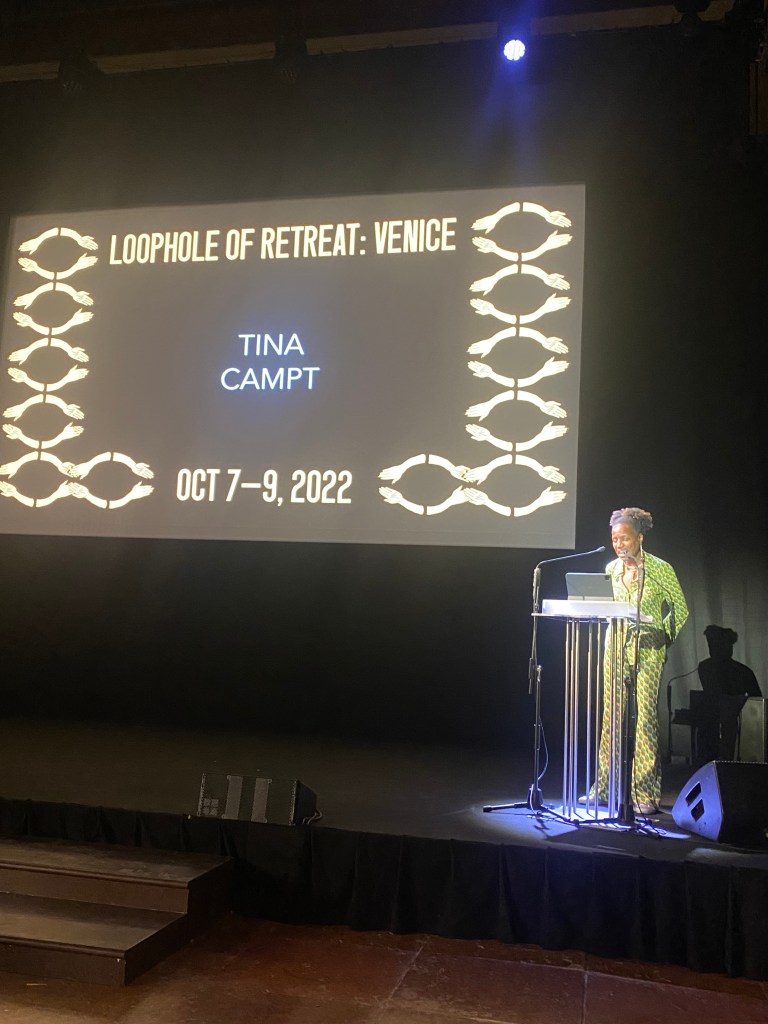
Professor Campt sweetly answered me: ” You can’t do all by yourself. But the fact you acknowledge is the first step of change. The fact you are here is the first step of change”.
And this is one of the main reasons for the blog: acknowledge and address to start a change. It won’t be an overnight situation, but anytime, with our words and with our work we can make a little change, by questioning something about your life and health, challenging a situation that could benefit you, and empowering you. All this means we are doing our job as health professionals but mostly as human being.
I don’t know and I don’t think there are definitive answers to the questions above, but I think every time at the retreat I heard laughs, the “mmmh mmmmh”, I was seeing the hugs between each other, hearing the comfort words, or every time I see the messages you send to our blog, the collaboration we make with other realities, the contents we create and even me writing this post, all this I believe are sounds of our care and defines our frequency.
Let’s keep it like this.
Let’s take care of each other, always.
 The Feminist Health CIC