
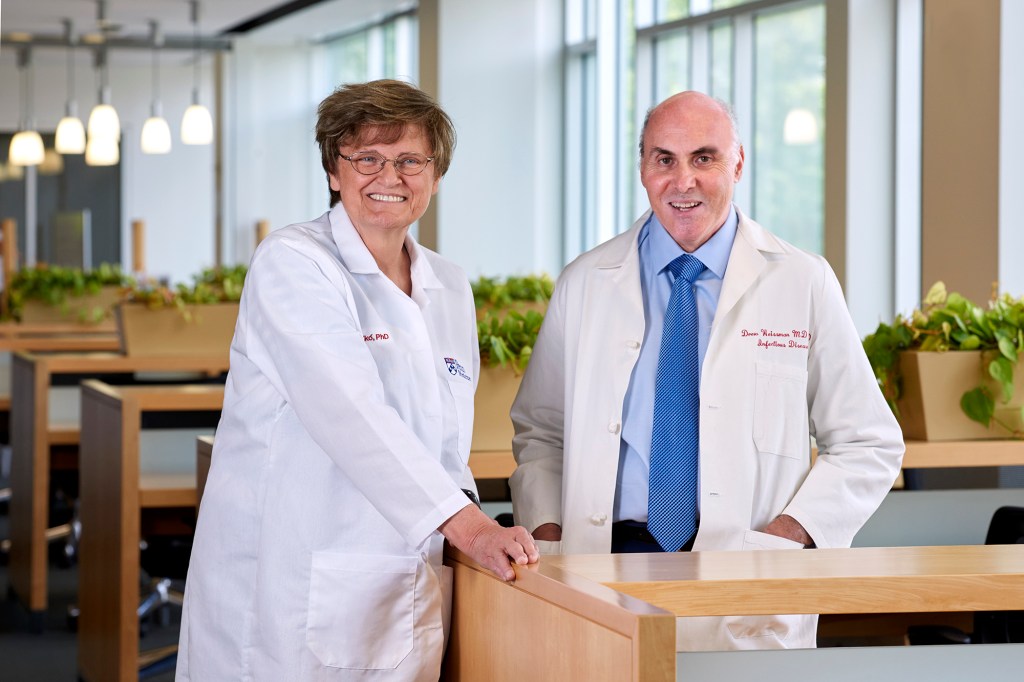
As we close the chapter of 2023, we believe it is important to end on a high note, celebrating the grand success of Katalin Kariko and Drew Weissman, who were awarded the Nobel Prize for Medicine in 2023. These two have been true pioneers in medicine through their research, which led to the development of the COVID-19 vaccine. Their work has provided care to copious amounts of people despite the challenges and rejections they faced in their careers. In honour of these two magnificent scientists, our final newsletter will focus on their life-saving work.
Who are Katalin Kariko and Drew Weissman?
Katalin Kariko was born on January 17, 1955, in a town called Szolnok in Hungary. Her educational background in biology and biochemistry was obtained at the Hungarian University of Szeged, where she obtained her doctorate in 1982. This was three years before she moved to the United States of America. In those three years, she began her lifelong research at the Szeged Biological Research Centre, where her focus was on RNA, particularly its antiviral activity alongside modified synthetic mRNA. Upon moving to the United States of America in 1985, she worked as a postdoctoral researcher at Temple University. In 1989, she began working at the University of Pennsylvania Medical School, and eight years later, she began her collaborative research with Drew Weissman. When she initially began working at the University of Pennsylvania, she collaborated with a cardiologist named Elliot Barnathan, and together they proved that the production of new protein cells can be directed by inserting mRNA into cells. This discovery led to her study of gene therapy based on mRNA. Sometime after this, she had no funding, but she wanted to continue her work, so she was going to leave the University of Pennsylvania. She then began working with Drew Weissman, and they had a common goal: using mRNA to cause the body to develop immunity to viral pathogens. Currently, she is both a professor of neurosurgery at the University of Pennsylvania and the senior vice president at the BioNTech company, where she began in 2013 overseeing the work on mRNA, which played a major role in the synthesis of the COVID-19 vaccines.
Drew Weissman was born on September 7, 1959, in an American town called Lexington, Massachusetts. He was a sporty boy, participating in martial arts. He worked at his engineer father’s company, which produced satellite optical mirrors when he was in high school. At Brandeis University, he obtained his bachelor’s and master’s degrees in enzymology and biochemistry. For his doctoral degree in immunology and microbiology, he attended Boston University and graduated in 1987. His residency was at Beth Israel Deaconess Medical Center, and in 1990, he completed his fellowship at the National Institute of Health in Maryland. After his fellowship, he began his research under the supervision of Anthony Fauci, an immunologist. Drew Weissman joined the University of Pennsylvania in 1997 when he began working in the medical faculty. His work was focused on dendritic cells and the development of RNA therapeutics. Dendritic cells are essential in immune surveillance. He is currently a professor of medicine at the medical school of the University of Pennsylvania.
What work have Katalin Kariko and Drew Weissman done?
When Katalin Kariko and Drew Weissman began their work together, they were focused on discovering how mRNA can be used to lead the body into developing immunity against viral pathogens. Through their work, they patented the non-immunogenic nucleoside-modified RNA technology in 2005. This came about when they discovered the link between reduced immunogenicity and specific modified mRNA nucleosides, which is the modification of mRNA to cause a desired protein production response in the body. This modified mRNA has the added benefit of staying active longer than normal mRNA, meaning it can enter cells and produce proteins resistant to disease. In an effort to make this technology readily available for everyone, they started a company, RNARx. Later, Moderna and BioNTech, two large biotechnology companies, were given the licence for the non-immunogenic nucleoside-modified RNA technology. Both Moderna and BioNTech have further developed RNA therapeutics, with multiple clinical trials underway. The COVID-19 pandemic is what accelerated the breakthrough in RNA therapeutics, where synthetic technologies were at the forefront since it meant there was no need for actual viral particles and mRNA vaccines were produced at a quicker rate than traditional vaccines, which is exactly what was needed in the global pandemic.
Other Awards
Along with the Nobel Prize for Medicine, Katalin Kariko and Drew Weissman have been awarded these prizes:
- Lewis S. Rosenstiel Award for Distinguished Work in Basic Medical Research (2020)
- Lasker-DeBakey Clinical Medical Research Award (2021)
- Louisa Gross Horwitz Prize (2021)
- Harvey Prize in Human Health (2021)
Why is being awarded the Nobel Prize for Medicine in 2023 an important event?
Katalin Kariko has become the thirteenth woman to be awarded the Nobel Prize in medicine since the introduction of the award in 1901.
Katalin Kariko, along with former winners of the Nobel Prize for Medicine, are a true definition of tenacity and determination. They faced challenges in funding, support, etc., yet the aim of their research was far greater than those challenges. Their stories teach us the power of never giving up and always finding a way around difficulties in order to achieve what we desire to achieve.
Another personality trait these women have in common is their sense of curiosity, which led them to keep investigating and diving deeper into their research. We ought to be more curious, as it will lead us to new discoveries that can change our lives and the lives of others too. As the famous quote by Albert Einstein goes, “Curiosity is more important than knowledge”.
 The Feminist Health CIC